
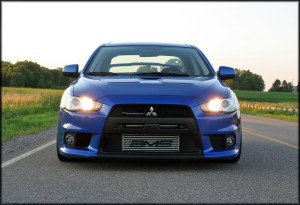
There are still some people out there who say “there is no replacement for displacement”, then when their large displacement V8 Camaro or Mustang gets blown away by a little 2-liter Lancer Evolution they have a bit of a hard time explaining themselves. The truth is that in the industry there is a very direct “replacement for displacement” and that is a turbocharger. The purpose of any form of forced induction is to give a certain sized motor the power of a larger one. It’s true that a larger motor will make more power than a smaller motor if both have the same turbo/boost level/compression ratio, but that is not how turbos are used in the industry. In reality, they are used to make cars with smaller motors give similar performance to cars with big motors.

The simple fact is that turbos boost an engine’s efficiency level to an astounding degree. It is impressive for a naturally aspirated motor to put out 100hp for every liter of displacement, meaning if it’s a 3 liter engine it would need to make 300hp or more. In order to reach this point, these engines have to be heavily tuned, and every possible benefit must be exploited (no matter how small). Turbocharged engines are able to achieve such efficiency with great ease. In fact, it’s hard to think of a modern turbocharged car that doesn’t achieve 100hp/L.

Because of this boost I efficiency cars are able to use smaller engines and thus achieve higher fuel mileage and less weight without making any sacrifices in performance. This clear advantage has been noticed and more and more companies are turning to turbocharging as a means to meet new fuel consumption and emissions requirements. It is quite evident that this is the direction the industry is moving, especially with the advent of technology that reduces annoying turbo lag to an unnoticeable level.

There is a new sort of turbocharged car that has emerged, one that is so refined, smooth, and responsive that you wouldn’t even realize that it’s turbocharged just by driving it. Most luxury car brands have turned to using twin turbo setups with tiny turbochargers instead of one larger turbo that would take time to kick in. Because of this, the notion of “lag” is almost a thing of the past for most of such cars.
The pros of this turbo revolution are pretty obvious, better efficiency helps everything about the way a car performs. The cons are more personal. One thing that does bug me and many other enthusiasts is the realization that the days of those glorious, highly tuned, normally aspirated engines may soon be coming to an end, and while performance will actually increase, there is something about these N/A motors that we will all sorely miss. For many people there will be a feeling of a loss of some of the soul present in many cars.

From a purely objective perspective turbocharging is the way to go for the industry bar none. Turbo technology has come a long way from the loud, laggy, fire-breathing monsters of old such as the Ferrari F40. As turbo technology becomes more refined it is only natural that its appeal would broaden, which it has. Yes, the N/A purity will be missed in many cases, but I doubt that such engines will die out altogether; while I love the sound of a well-tuned motor, the sound of a great engine with some wastegate rushing and pressure blow off mixed in is just as good, if not better. Either way, I am of the idea that it is better to embrace looming changes than fight them, especially when they offer a clear advantage.
-Nick
 Mind Over Motor